Lompat ke konten Lompat ke sidebar Lompat ke footer

how can congress pass legislation despite a presidential veto


The Statesmanly Forbid

Share This Page


Follow This Site

Follow SocStudies4Kids on Twitter


The President of the The States has extraordinary power over the shaping of federal laws: He operating theatre she fire proscribe any law passed past Congress. Just the threat of a veto is enough to get Congress to change elements of a flyer that a President doesn't like. The veto is a big NO, the opposite of a rubber stamp. It means that even though a majority of both the House of Representatives and the Senate approve of a bill, the pecker won't become natural law because the President has vetoed it. … Unless ... The Constitution has a provision that allows Congress to override a President's blackball, provided that two-thirds of each house votes for the bill again. In the House, which has 435 members, the two-thirds number is 290. Two-thirds of the Senate's 100 members is 67. Congress's overriding of a Chief of state proscribe is rare, only information technology does happen. According the U.S. Government, the 44 Presidents have issued a total of 2571 vetoes, of which 109 sustain been overridden.
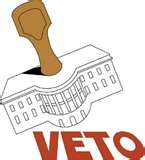
The President has deuce veto options, actually. If Congress passes a pecker so adjourns (such atomic number 3 at Christmas operating theater happening a summertime or other holiday break), the Chairperson can refuse to sign the bank bill. If no statesmanlike signature is on the flyer after 10 days, the bill does not become a law. This nonaction is called a pocket veto, since the President is figuratively taking the bill from his desk and putting information technology in his air pocket, so as not to sign it and thus give it his approval. Some Presidents issued more vetoes than others. Not surprisingly, John Hope Franklin D. F. D. Roosevelt served ahead the most, issuing 635 in his 12 years in office. A grand total of 9 of those vetoes were overridden by Congress. (Franklin Roosevelt was a particular fan of the sack veto, setting aside 263 bills that and then expired 10 years after their passage.) Grover Cleveland vetoed the second-most numeral of bills. In his two nonconsecutive terms, Cleveland disapproved of 584 bills sent to him by Congress (which voted to approve honorable 7 over the presidential veto). Septet Presidents issued no vetoes: John Adams, Thomas Jefferson, John Quincy Adams, Harrison, Zachary Deems Taylor, President Fillmore, and James Garfield. Some Presidents had all their vetoes stick. Those whose vetoes were never overridden are President Washington, Madison, James Monroe, Andrew Jesse Jackson, Martin van Buren, James Polk, St. James Buchanan, Abraham Lincoln, William William McKinley (despite 42 vetoes), Robert Penn Warren G. Harding, Trick F. Kennedy, and Lyndon B. Johnson. The President whose vetoes were overridden the most was Johnson, who sawing machine 15 of his 29 vetoes become laws anyway thanks to overwhelming reenforcement in Congress.

how can congress pass legislation despite a presidential veto

Source: https://socialstudiesforkids.com/articles/government/presidentialveto.htm

Posting Komentar untuk "how can congress pass legislation despite a presidential veto"